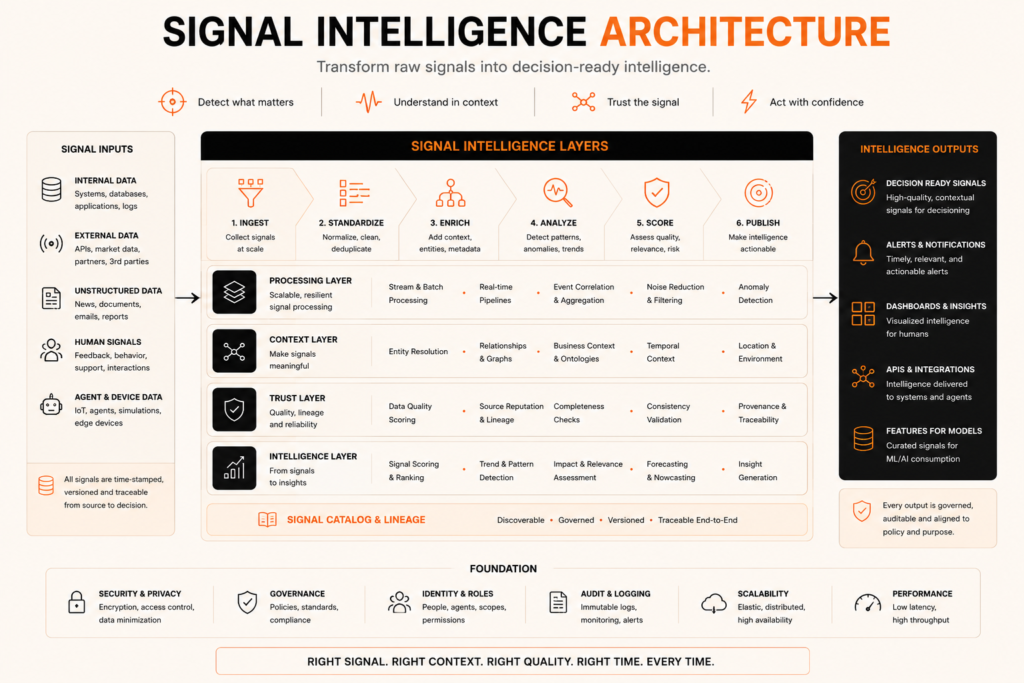
Signal Intelligence Layer
The Cognitive Infrastructure for Decision-Aware AI Systems
Artificial intelligence transformed prediction.
It accelerated classification, recommendation, automation, generation, optimization, and probabilistic forecasting at unprecedented scale. Modern AI systems can process more information than any human organization ever could. Models have become faster, larger, and increasingly capable of generating outputs that resemble reasoning.
And yet — despite this technological acceleration — organizations continue to experience systemic decision failure.
Enterprises still struggle with:
- contradictory decisions,
- fragmented governance,
- operational blind spots,
- unstable automation,
- strategic drift,
- and misaligned execution.
This contradiction reveals a deeper structural problem inside modern AI architectures.
The problem is not intelligence alone.
The problem is that most systems were built to predict — not to govern decisions.
As a result, organizations optimized data pipelines, model architectures, and automation layers without engineering the cognitive infrastructure required to determine:
- which signals matter,
- when they matter,
- how they should influence decisions,
- and how systems adapt when environments change.
This missing capability represents one of the largest architectural gaps in modern AI systems.
At DECIRA, we define this missing capability as:
The Signal Intelligence Layer
The Signal Intelligence Layer is the cognitive infrastructure responsible for transforming raw information into decision-relevant signals capable of guiding governable action.
It is the missing layer between prediction and decision execution.
It is the foundation of signal-aware AI systems.
And it represents a fundamental shift from predictive infrastructure toward engineered decision infrastructure.
Why AI Systems Still Fail
Most modern AI architectures follow a similar logic:
Data → Model → Prediction → Action
This architecture assumes that better predictions naturally produce better decisions.
But this assumption repeatedly fails in practice.
Because decision systems do not operate in static environments.
They operate under:
- uncertainty,
- conflicting incentives,
- changing constraints,
- dynamic objectives,
- incomplete information,
- and evolving organizational contexts.
A model can be highly accurate while the system itself becomes strategically blind.
This happens because prediction quality alone cannot determine:
- which information should matter,
- how signals should be prioritized,
- when escalation is required,
- or whether actions remain aligned with objectives.
The failure emerges not at the level of prediction accuracy.
It emerges at the level of signal interpretation.
Modern AI systems are capable of generating outputs at enormous scale while lacking coherent mechanisms for governing signal relevance across decisions.
As organizations increase automation, the cost of signal failure grows exponentially.
The result is not merely operational inefficiency.
The result is systemic instability.
Signals Are Not the Same as Data
One of the most important distinctions in Decision Engineering is the distinction between data and signals.
Data is passive.
Signals are decision-relevant.
This difference changes how intelligent systems must be designed.
Data refers to observable information.
Signals refer to information capable of altering decision behavior.
Not all information becomes a signal.
A signal only exists relative to:
- objectives,
- context,
- constraints,
- incentives,
- governance structures,
- and decision architecture.
The same data point can be:
- irrelevant in one system,
- critical in another,
- or dangerous under different constraints.
This means signal relevance is not fixed.
Signal relevance is architectural.
This is precisely why organizations can possess enormous quantities of data while remaining unable to make coherent decisions.
The problem is not informational scarcity.
The problem is the absence of signal intelligence.
What Is the Signal Intelligence Layer?
The Signal Intelligence Layer is the architectural layer responsible for:
- signal detection,
- signal prioritization,
- signal weighting,
- signal governance,
- signal propagation,
- and signal adaptation across decision systems.
It transforms environmental information into governable decision influence.
Unlike traditional analytics systems, the Signal Intelligence Layer does not simply observe information.
It determines:
- what becomes visible,
- what becomes actionable,
- and how systems respond to change.
The Signal Intelligence Layer therefore functions as a form of cognitive infrastructure.
It defines how organizations interpret reality operationally.
Without this layer, AI systems remain reactive rather than adaptive.
They process information without understanding how signals should influence coordinated action.
This distinction becomes increasingly critical as enterprises move toward:
- agentic AI systems,
- autonomous workflows,
- enterprise orchestration,
- and multi-agent decision architectures.
Because as systems scale, signal complexity scales with them.
The Emergence of Signal Blindness
One of the most dangerous phenomena in modern AI systems is signal blindness.
Signal blindness occurs when systems fail to recognize meaningful environmental change despite continuous data processing.
This often happens because optimization systems overfit stable assumptions while environments evolve dynamically.
The organization continues optimizing existing objectives while critical signals shift outside the visibility of the system.
Over time, this creates:
- decision drift,
- strategic misalignment,
- governance fragmentation,
- and operational instability.
Importantly, signal blindness is rarely visible immediately.
It accumulates gradually.
The system appears functional until environmental divergence becomes severe enough to trigger cascading failure.
Examples include:
- organizations optimizing outdated KPIs,
- autonomous systems reinforcing obsolete assumptions,
- agents amplifying conflicting objectives,
- or enterprises reacting too late to structural market shifts.
In these environments, more prediction does not solve the problem.
What is missing is signal awareness.
Signal Sensitivity and Adaptive Decision Systems
At DECIRA, Signal Intelligence is closely connected to another foundational Decision Engineering concept:
Signal Sensitivity
Signal Sensitivity measures how responsive a system is to meaningful environmental change.
It reflects whether systems can detect weak signals early enough to adapt decisions before failure escalates.
High Signal Sensitivity systems are capable of:
- recognizing anomalies,
- detecting emerging risks,
- adapting to environmental shifts,
- and updating decision logic dynamically.
Low Signal Sensitivity systems tend to:
- react too slowly,
- reinforce outdated assumptions,
- ignore weak signals,
- and amplify operational risk.
Traditional AI metrics rarely capture this capability.
Most AI evaluation frameworks focus on:
- model accuracy,
- throughput,
- latency,
- precision,
- or benchmark performance.
But adaptive decision systems require a fundamentally different question:
Did the system recognize the right signals early enough to alter action?
This is not merely a machine learning problem.
It is a decision architecture problem.
Why Signal Intelligence Matters in Multi-Agent Systems
As organizations increasingly deploy multi-agent AI systems, signal governance becomes exponentially more important.
Multi-agent environments introduce structural complexity because different agents:
- observe different data,
- optimize different objectives,
- receive different incentives,
- and interpret signals differently.
Without coherent signal governance, systems begin to fragment operationally.
Agents stop coordinating around shared decision logic.
Instead, they optimize locally.
This creates:
- signal divergence,
- contradictory actions,
- recursive errors,
- escalation conflicts,
- and governance ambiguity.
In these environments, failures do not emerge because individual agents are unintelligent.
Failures emerge because systems lack coordinated signal architecture.
The future of scalable AI therefore depends not only on intelligent agents.
It depends on governable signal ecosystems.
The Shift From Prediction Infrastructure to Cognitive Infrastructure
The AI industry has largely focused on computational infrastructure.
Cloud systems scaled compute.
Data infrastructure scaled storage.
Model infrastructure scaled prediction.
But intelligent organizations require something more fundamental:
cognitive infrastructure.
Cognitive infrastructure determines how systems interpret environmental reality operationally.
The Signal Intelligence Layer functions as precisely this infrastructure.
It governs:
- signal relevance,
- signal prioritization,
- decision escalation,
- adaptive coordination,
- and organizational awareness.
This represents a major architectural transition.
The next generation of intelligent systems will not compete solely on predictive capability.
They will compete on:
- adaptability,
- resilience,
- coordination,
- and decision coherence.
Those capabilities depend on Signal Intelligence.
The Core Components of the Signal Intelligence Layer
The Signal Intelligence Layer consists of several interconnected architectural capabilities.
1. Signal Detection
Systems must continuously detect meaningful environmental signals across operational domains.
This includes:
- behavioral signals,
- operational anomalies,
- governance deviations,
- strategic indicators,
- and weak emerging patterns.
Signal detection must operate beyond static dashboards.
It must identify signals before failure becomes observable.
2. Signal Classification
Not all signals carry equal decision relevance.
The architecture evaluates signals based on:
- urgency,
- reliability,
- strategic impact,
- uncertainty,
- volatility,
- and downstream decision implications.
This prevents organizations from treating all information equally.
3. Signal Prioritization
Signals compete for organizational attention.
The Signal Intelligence Layer determines:
- which signals influence decisions,
- how strongly they influence action,
- and which escalation pathways are required.
Without prioritization, organizations drown in informational noise.
4. Signal Governance
Signal governance determines:
- who owns signal interpretation,
- who can override decisions,
- how escalation occurs,
- and how accountability is maintained.
This is especially critical in agentic systems where autonomous actions must remain governable.
5. Signal Propagation
Signals move across systems dynamically.
The architecture governs:
- how signals are distributed,
- which agents receive them,
- how signals transform across workflows,
- and how decision dependencies evolve.
Without propagation controls, organizations experience coordination collapse.
6. Feedback Integrity
Signal systems must continuously learn whether signals improved outcomes.
This enables:
- adaptation,
- recalibration,
- and decision evolution.
Without feedback integrity, organizations cannot improve decision quality structurally.
The Relationship Between Signal Intelligence and Decision Quality
Signal Intelligence is directly connected to decision quality.
Poor signal architecture creates:
- incomplete decisions,
- delayed decisions,
- inconsistent decisions,
- and strategically misaligned actions.
At DECIRA, Signal Intelligence integrates directly with:
DQI — Decision Quality Index
DQI measures decision quality structurally rather than evaluating outcomes alone.
This includes evaluating:
- information quality,
- objective alignment,
- governance integrity,
- transparency,
- and risk coherence.
This distinction matters because successful outcomes do not necessarily indicate high-quality decisions.
Likewise, poor outcomes do not always imply structurally flawed decision processes.
Signal Intelligence improves DQI by strengthening the integrity of the signals entering decision systems.
Signal Intelligence and Enterprise Governance
Enterprises today operate under increasing governance pressure.
Organizations must ensure systems remain:
- explainable,
- auditable,
- governable,
- transparent,
- and accountable.
However, most AI systems cannot explain:
- why specific signals mattered,
- how signals were prioritized,
- or how signal interpretation changed over time.
This creates major governance gaps.
The Signal Intelligence Layer addresses these gaps by introducing:
- signal traceability,
- governance visibility,
- escalation mapping,
- and decision accountability.
This becomes particularly important in:
- healthcare,
- pharmaceuticals,
- finance,
- logistics,
- manufacturing,
- and regulated enterprise AI environments.
Because future AI governance will require not only explainable models.
It will require explainable signal architectures.
The Hidden Economic Cost of Signal Failure
Signal failure produces enormous hidden economic costs.
Organizations often focus on visible operational failures while ignoring invisible signal degradation.
Over time, weak signal architecture produces:
- duplicated initiatives,
- coordination inefficiencies,
- governance fragmentation,
- delayed strategic adaptation,
- and escalating organizational entropy.
This creates systemic inefficiency even when local optimization appears successful.
The organization becomes operationally active while strategically incoherent.
Signal Intelligence addresses this by aligning systems around decision-relevant awareness.
Why Most AI Transformation Initiatives Fail
Many AI transformation initiatives fail not because the technology is weak, but because organizations lack decision infrastructure.
They deploy models without redesigning:
- decision ownership,
- governance structures,
- escalation logic,
- signal prioritization,
- and adaptive coordination mechanisms.
As a result:
- automation scales fragmentation,
- prediction amplifies noise,
- and organizations lose decision coherence.
The Signal Intelligence Layer enables organizations to transition from fragmented automation toward coordinated decision ecosystems.
DECIRA and the Future of Signal-Aware Systems
DECIRA was designed around a core architectural principle:
AI systems require engineered decision infrastructure.
The Signal Intelligence Layer represents one of the foundational components of this infrastructure.
Within DECIRA, Signal Intelligence operates alongside:
- Decision Objects,
- Decision Flow Orchestration,
- Decision Control Layer,
- DQI,
- and DES OS.
Together, these systems create:
governable cognitive infrastructure for AI decision systems.
This architecture transforms AI from:
prediction-centric infrastructure
into
decision-centric infrastructure.
From Reactive Organizations to Adaptive Enterprises
Most organizations today remain reactive.
They respond after failure occurs.
Signal-aware organizations operate differently.
They detect deviations early.
They identify structural shifts before collapse emerges.
They adapt decision architectures dynamically.
This transition from reactive systems toward adaptive systems will define the next generation of intelligent enterprises.
And adaptation depends on Signal Intelligence.
The Future of AI Depends on Signal Intelligence
The future of AI will not be determined solely by larger models or faster inference.
The defining capability of next-generation systems will be:
- adaptive coordination,
- signal governance,
- decision resilience,
- and cognitive coherence.
Organizations capable of engineering Signal Intelligence will gain:
- greater adaptability,
- stronger governance,
- improved operational resilience,
- and higher-quality decisions.
Organizations that fail to engineer signal-aware systems will increasingly struggle with:
- automation instability,
- governance failures,
- decision fragmentation,
- and strategic blindness.
The future belongs to systems capable of transforming signals into governable action.
DECIRA
Building the Cognitive Infrastructure for Decision-Aware AI
DECIRA is building the infrastructure layer for engineered decision systems.
The Signal Intelligence Layer represents a critical part of that architecture.
Because AI systems do not fail only at prediction.
They fail when systems cannot determine:
- what matters,
- why it matters,
- and how decisions should adapt.
Signal Intelligence transforms AI from informational processing into decision-aware cognition.
This is the next architectural layer of intelligent systems.
This is the future of cognitive infrastructure.
This is DECIRA.