Decision Quality Is What Actually Determines Outcomes
AI doesn’t fail because of models.
It fails because of decisions.
For years, organizations have optimized for accuracy, performance, and scale.
But despite better models and more data, outcomes remain inconsistent.
Why?
Because accuracy does not choose actions.
Decision quality does.
Decision quality is the missing metric — the one that determines whether a system produces good outcomes, not just correct predictions.
If you don’t measure decision quality, you are not optimizing outcomes.
You are optimizing guesses.
What Is Decision Quality?
Decision quality is a measure of how good a decision is — given objectives, constraints, uncertainty, and available information.
It answers a fundamentally different question than accuracy.
- Accuracy asks: Was the prediction correct?
- Decision quality asks: Was the decision good?
A decision can be based on an accurate prediction and still be wrong.
Because decisions are not just about likelihood —
they are about trade-offs, risk, alignment, and execution.
Decision quality captures this complexity.
Why Accuracy Is Not Enough
Most AI systems today are evaluated using metrics like:
- Accuracy
- Precision / recall
- F1 score
- AUC
These metrics measure prediction performance.
They do not measure decision outcomes.
This creates a structural problem.
A model can be:
- Highly accurate
- Well-calibrated
- Statistically robust
And still produce:
- Bad decisions
- Misaligned actions
- High-risk outcomes
Because the system lacks decision structure.
Examples are everywhere:
- A credit model predicts default risk accurately but denies profitable customers
- A recommendation system optimizes clicks but reduces long-term retention
- An autonomous agent acts efficiently but violates constraints
The problem is not prediction.
It is decision quality.
The Shift: From Model Metrics to Decision Metrics
To build reliable AI systems, organizations must shift from:
Model performance → Decision performance
This means:
- Evaluating decisions, not just predictions
- Designing decision structures, not just models
- Measuring outcomes, not just probabilities
Decision quality becomes the primary metric.
Everything else becomes input.
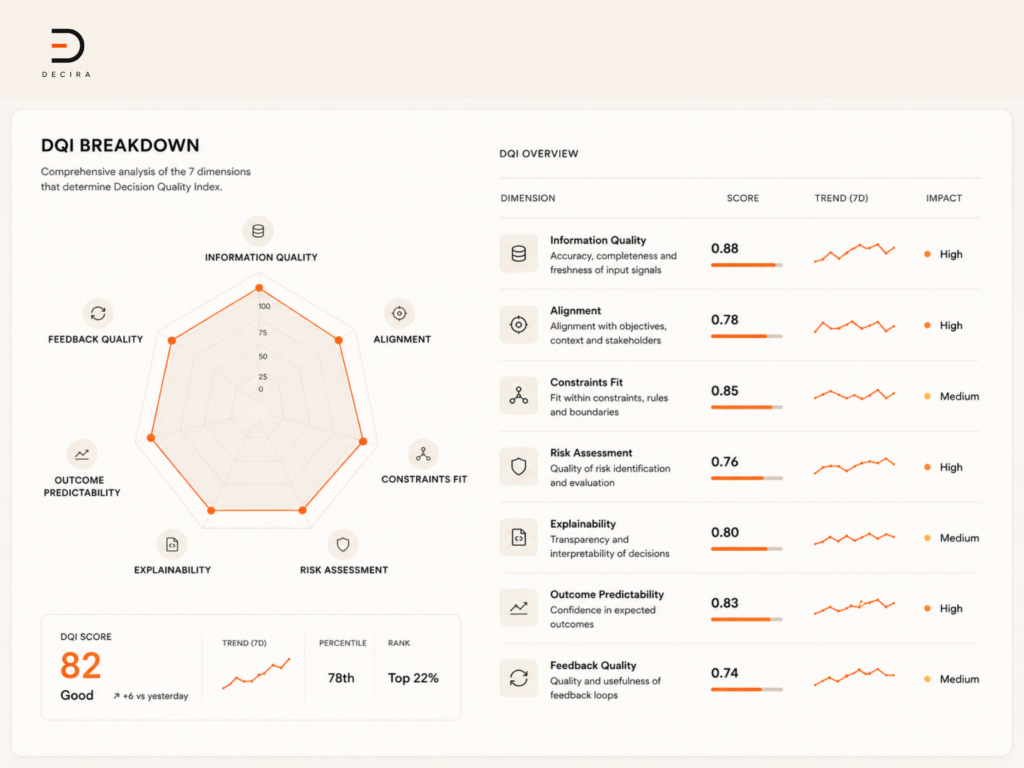
The Decision Quality Index (DQI)
To operationalize decision quality, we introduce:
Decision Quality Index (DQI).
DQI is a structured metric that evaluates how good a decision is based on its architecture — not just its outcome.
It measures five core dimensions:
1. Information Quality
Is the decision based on reliable, relevant, and sufficient data?
Poor information leads to weak decisions — even if models are accurate.
2. Alignment
Does the decision align with objectives, strategy, and constraints?
Misalignment is one of the most common causes of failure.
3. Transparency
Can the decision be understood, explained, and audited?
Opaque decisions create risk and limit improvement.
4. Risk
What is the downside exposure of the decision?
Good decisions manage risk — not ignore it.
5. Structural Integrity
Is the decision well-formed?
This includes:
- Clear options
- Defined constraints
- Explicit trade-offs
- Assigned ownership
Without structure, there is no decision system.
Why Decision Quality Matters
Decision quality is not a theoretical concept.
It has direct impact on:
1. Business Outcomes
Better decisions lead to:
- Higher profitability
- Reduced risk
- Improved efficiency
2. AI Performance
Even the best models fail without decision structure.
Decision quality ensures models are used correctly.
3. Organizational Alignment
Clear decision structures reduce:
- Confusion
- Conflicts
- Delays
4. Governance and Compliance
Decision quality enables:
- Auditability
- Accountability
- Regulatory alignment
Decision Quality vs Decision Outcomes
A critical distinction:
Decision quality is not the same as outcome quality.
A good decision can lead to a bad outcome — due to uncertainty.
A bad decision can lead to a good outcome — by chance.
This is why measuring outcomes alone is insufficient.
Decision quality evaluates:
- The process
- The structure
- The reasoning
Not just the result.
Decision Quality in AI Systems
In AI systems, decision quality determines whether intelligence translates into action.
Without decision quality:
- Predictions remain unused
- Automation becomes risky
- Agents behave unpredictably
With decision quality:
- Actions are aligned
- Systems are controllable
- Outcomes are optimized
Decision quality is the bridge between intelligence and execution.
Decision Quality in Multi-Agent Systems
As systems evolve into multi-agent environments, decision quality becomes even more critical.
Without a shared decision structure:
- Agents optimize locally
- Objectives conflict
- Constraints are violated
- Systems become unstable
Decision quality enables:
- Coordination
- Consistency
- System-level optimization
It transforms a swarm into a system.
How to Improve Decision Quality
Improving decision quality requires a shift in how decisions are treated.
1. Make Decisions Explicit
Identify key decisions and define them clearly.
2. Structure Decisions
Define:
- Objectives
- Constraints
- Options
- Trade-offs
3. Assign Ownership
Every decision must have:
- A responsible owner
- Clear accountability
4. Integrate AI Properly
Use models as inputs — not decision-makers.
5. Measure with DQI
Evaluate decisions consistently.
6. Create Feedback Loops
Learn from decisions and improve over time.
Decision Quality as a System
Decision quality is not a one-time improvement.
It is a system.
A decision system includes:
- Structured decision objects
- Defined governance
- Continuous measurement
- Feedback mechanisms
This is what enables scalability.
The Future: Decision-Centric Organizations
Organizations that win in the AI era will not be those with the best models.
They will be those with the best decisions.
This requires a new approach:
- Decision engineering instead of model tuning
- Decision metrics instead of prediction metrics
- Decision systems instead of isolated tools
Decision quality becomes a competitive advantage.
Decision Quality and the Cognitive Economy
We are entering the Cognitive Economy –
where value is created through decisions.
In this world:
- Data is abundant
- Models are commoditized
- Decisions are the differentiator
Decision quality becomes the core metric of value creation.
From Intelligence to Decision Quality
AI has unlocked intelligence.
But intelligence without decision quality is incomplete.
The next frontier is not smarter models.
It is better decisions.
Decision Quality Is the New Standard
Decision quality defines:
- Whether systems succeed or fail
- Whether AI creates value or risk
- Whether organizations scale effectively
It is the metric that matters.
If you are optimizing accuracy, you are optimizing the wrong layer.
Start optimizing decision quality.
→ Measure decisions with DQI
→ Design decision architecture
→ Build systems that act, not just predict
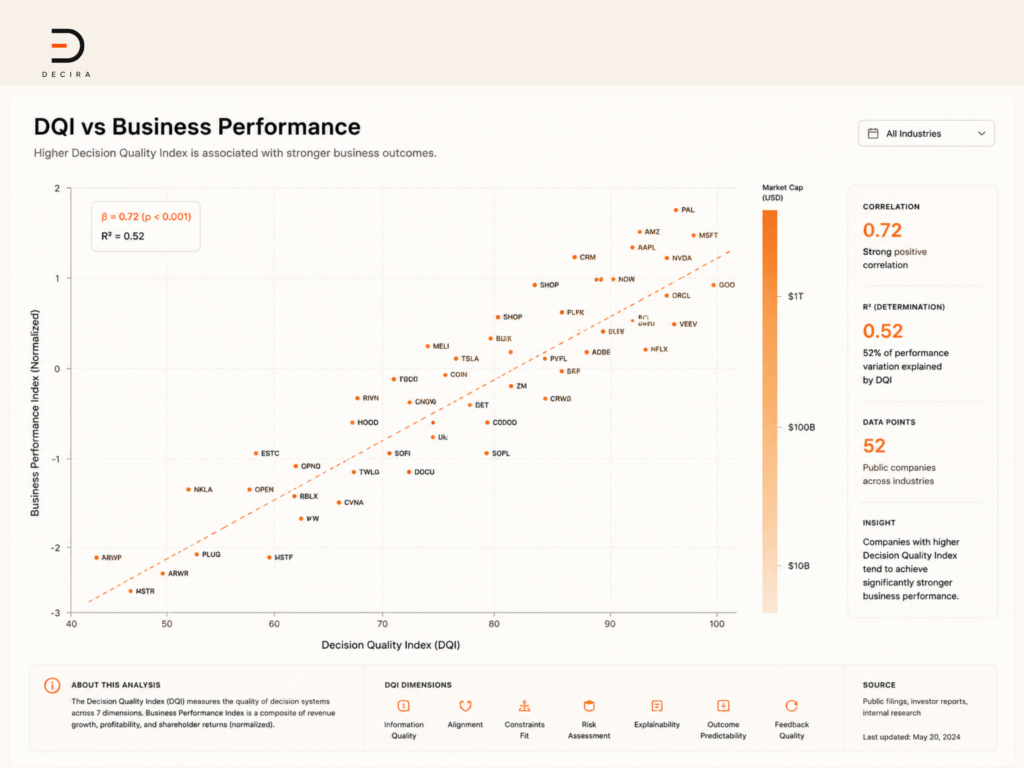
Simulated enterprise dataset based on theoretical DQI assumptions.