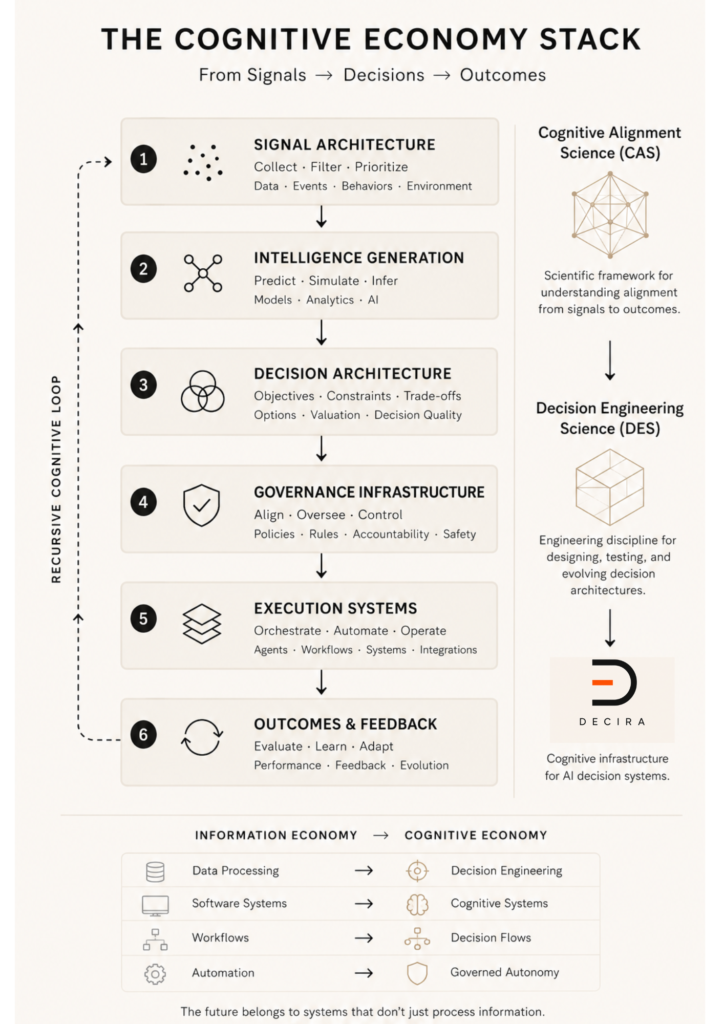
The Cognitive Economy Stack
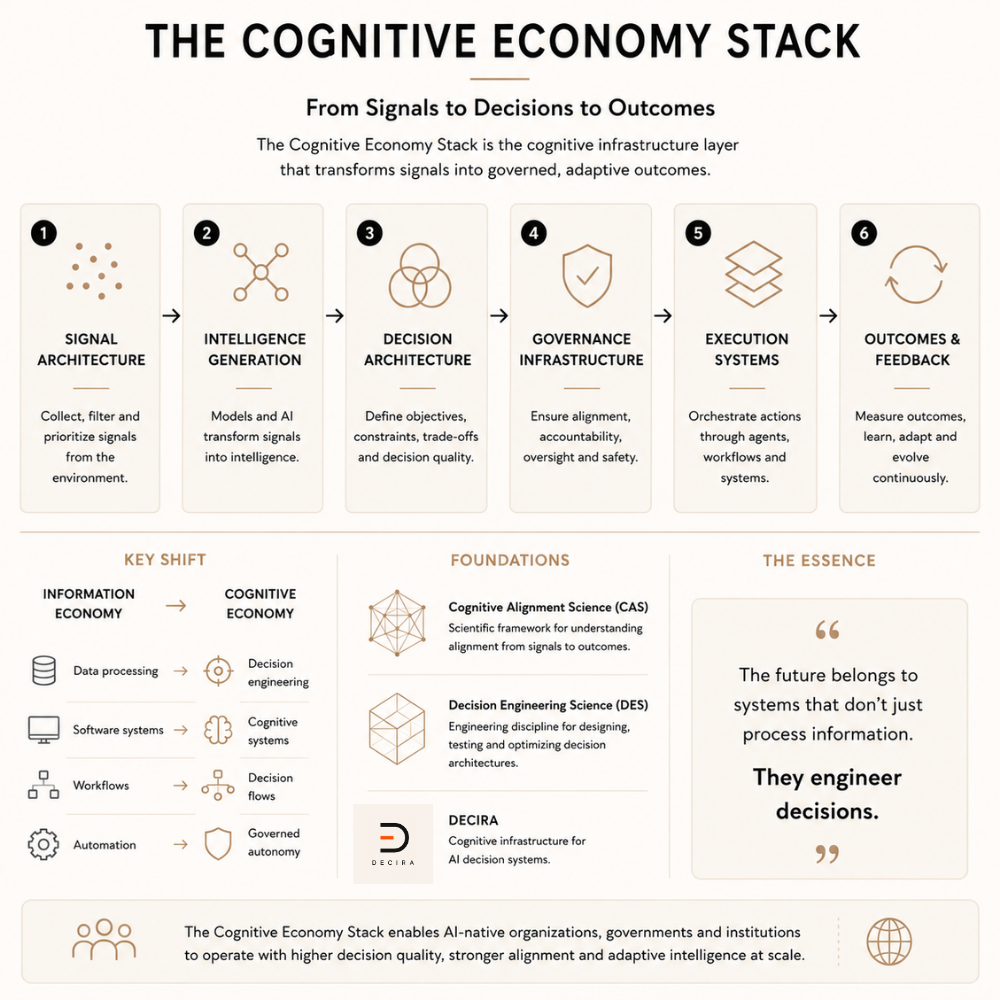
The Cognitive Economy Stack
From Signals to Decisions to Outcomes
Building the Cognitive Infrastructure Layer for AI Systems
Artificial intelligence transformed the economics of prediction. Models became faster, inference became cheaper, and computational systems achieved unprecedented capabilities across language, perception, optimization, and simulation. Yet despite these advances, institutional decision quality has not improved at the same rate as computational intelligence.
This discrepancy reveals a deeper structural problem.
Modern AI systems excel at generating predictions, but most organizations still lack formal architectures capable of transforming intelligence into governed action. As a result, enterprises increasingly operate with extraordinary informational capability while remaining structurally fragile at the decisional level. Systems can generate outputs at planetary scale; however, they often struggle to coordinate objectives, maintain governance integrity, or preserve alignment across rapidly changing environments.
Consequently, the central challenge of the AI era is no longer intelligence generation alone. Instead, the challenge is decisional coherence.
This transition marks the emergence of a new economic paradigm: the Cognitive Economy.
Unlike the Information Economy, which optimized communication and computation, the Cognitive Economy optimizes decisions. Within this paradigm, the primary unit of strategic value is no longer information itself, but the ability to transform signals into coordinated, adaptive, and governable outcomes.
Beneath this transformation sits an entirely new infrastructural architecture:
The Cognitive Economy Stack.
This stack defines how intelligent systems convert environmental signals into decisions, actions, governance processes, and measurable outcomes across human and autonomous environments.
The Limits of Prediction-Centric AI
For more than a decade, the dominant assumption in AI has been relatively simple: better predictions lead to better decisions. In practice, this assumption increasingly fails under real-world conditions.
Prediction estimates probability.
Decision-making governs action.
Although these processes are related, they are not equivalent.
A predictive system may correctly forecast market behavior while contributing to catastrophic institutional outcomes. Likewise, a recommendation engine may optimize engagement metrics while simultaneously degrading governance quality, strategic alignment, or long-term stability.
The underlying issue is architectural rather than computational.
Most AI systems operate within inference-centric frameworks. They transform inputs into outputs efficiently, yet they rarely encode explicit structures for objectives, accountability, governance, or institutional trade-offs. Human operators therefore absorb the burden of interpretation, often through fragmented organizational processes that do not scale under autonomous conditions.
As AI systems become increasingly agentic, this missing decisional layer becomes impossible to ignore.
Traditional software executes predefined instructions. Agentic systems, by contrast, continuously generate actions under uncertainty. This changes the topology of risk entirely. Autonomous systems no longer participate passively in workflows; instead, they actively shape operational environments through dynamic decision-making.
The challenge is therefore shifting from computational intelligence toward cognitive governance.
From Information Infrastructure to Cognitive Infrastructure
Industrial economies were built on physical infrastructure.
Information economies were built on computational infrastructure.
The Cognitive Economy requires cognitive infrastructure.
This distinction is foundational because information systems and cognitive systems operate according to fundamentally different logics. Information systems organize data flows. Cognitive systems organize decision flows.
As organizations become increasingly dependent on autonomous coordination, the quality of their cognitive architectures begins to determine strategic performance. Consequently, competitive advantage shifts away from information access alone and toward the ability to structure decisions effectively under conditions of uncertainty, complexity, and scale.
This transformation is already visible across multiple sectors.
In finance, competitive advantage increasingly depends on decision latency, adaptive allocation, and institutional coordination. In healthcare, operational performance depends less on information availability and more on the orchestration of decisions between clinicians, AI systems, and governance structures. Meanwhile, defense systems are evolving toward distributed autonomous coordination architectures capable of managing rapidly changing operational environments.
Across industries, the pattern remains consistent:
The next generation of systems will not merely process information.
They will continuously transform signals into governed action.
Understanding the Cognitive Economy Stack
The Cognitive Economy Stack describes the infrastructural layers through which intelligent systems transform environmental signals into coordinated outcomes.
At a systems level, the stack contains six interconnected layers:
- Signal Architecture
- Intelligence Generation
- Decision Architecture
- Governance Infrastructure
- Execution Systems
- Outcome Feedback Systems
Together, these layers create a closed cognitive loop capable of supporting adaptive institutional behavior across human and autonomous environments.
Unlike traditional enterprise architectures, the Cognitive Economy Stack is not centered exclusively on software execution. Instead, it focuses on the engineering of cognition itself.
Layer I – Signal Architecture
Every cognitive system begins with signals.
Signals represent observable changes within an environment. These changes may include transactions, operational metrics, behavioral events, communications, sensor outputs, economic indicators, or environmental observations.
Historically, organizations struggled with information scarcity. Today, however, the dominant challenge is informational saturation.
Modern enterprises collect enormous quantities of data, yet increased informational throughput often reduces decisional clarity rather than improving it. This occurs because not all signals possess equal decisional relevance.
Most organizations optimize for data acquisition instead of signal architecture.
The difference is critical.
Data accumulation alone does not improve decision quality. In many environments, excessive signal volume produces operational noise, governance confusion, and institutional instability.
As a result, one of the defining questions of the Cognitive Economy becomes:
Which signals should influence action?
This is not merely a technical problem. Rather, it is an architectural and governance problem because signal prioritization implicitly reflects assumptions about value, relevance, legitimacy, and institutional intent.
Every signal architecture therefore encodes a theory of what matters.
Signal Sensitivity and Institutional Drift
Signal sensitivity determines how strongly systems react to environmental change.
Poorly engineered signal architectures generate systemic instability because they distort the relationship between observation and action. Over time, this creates forms of institutional drift that remain difficult to detect using traditional performance metrics.
Such drift may manifest as:
- optimization misalignment
- governance fragmentation
- feedback corruption
- strategic blindness
- reward distortion
- operational instability
Importantly, these failures often emerge before observable outcome collapse occurs. Most organizations evaluate performance retrospectively through lagging indicators. However, structural failure frequently begins much earlier at the signal layer itself.
Two institutions observing identical environments may produce radically different outcomes depending on how they prioritize and interpret signals.
Therefore, cognition is not simply about intelligence generation. It is about the structuring of relevance across dynamic environments.
This insight represents one of the foundational challenges of advanced AI governance and Cognitive Alignment Science.
Layer II – Intelligence Generation
The second layer of the Cognitive Economy Stack transforms signals into probabilistic representations.
This layer includes:
- prediction
- simulation
- classification
- forecasting
- optimization
- anomaly detection
- language generation
- inferential reasoning
Modern AI research has concentrated heavily within this domain. As a result, computational systems now achieve extraordinary capabilities across language modeling, perception, and pattern recognition.
Nevertheless, intelligence generation alone remains insufficient for coordinated institutional action.
The intelligence layer can estimate probability distributions, model scenarios, identify patterns, and generate recommendations. However, it cannot independently determine legitimacy, acceptable risk boundaries, governance priorities, or institutional trade-offs.
In other words, predictive intelligence does not inherently produce decisional coherence.
This distinction is fundamental.
Prediction estimates what is likely.
Decision-making governs what should happen.
The inability to separate these two layers remains one of the largest conceptual limitations within contemporary AI discourse.
Layer III – Decision Architecture
Decision Architecture represents the central layer of the Cognitive Economy Stack.
It is the domain in which intelligence becomes governed action.
Most organizations currently operate using implicit decisional systems distributed across human interpretation, institutional habits, undocumented incentives, and fragmented governance processes. Although these structures function under limited complexity, they fail to scale effectively within environments populated by autonomous agents and continuously adaptive systems.
Decision Architecture formalizes this missing layer.
It defines:
- objectives
- constraints
- trade-offs
- escalation pathways
- accountability structures
- ownership models
- admissible actions
- institutional priorities
- governance logic
- decision rights
Consequently, Decision Architecture functions as cognitive infrastructure for modern AI-native organizations.
Without explicit decisional structures, autonomous systems may optimize locally while simultaneously degrading systemic coherence at larger scales.
Decision Engineering and the Formalization of Decisions
The emergence of Decision Architecture gives rise to a broader discipline: Decision Engineering.
Decision Engineering treats decisions as structured engineering objects rather than informal managerial abstractions. Historically, organizations engineered software, databases, networks, and operational systems while leaving decisional logic largely implicit.
This asymmetry becomes unsustainable in the Cognitive Economy.
As autonomous systems scale, decisions must become:
- auditable
- governable
- measurable
- versioned
- simulatable
- stress-tested
- operationally executable
Decision Engineering therefore introduces a major conceptual shift:
Organizations must optimize not only intelligence generation, but the quality and structure of decisions themselves.
This shift may ultimately become as significant as the transition from analog to digital infrastructure.
Decision Objects and Shared Cognitive State
One of the foundational primitives of Decision Engineering is the Decision Object.
A Decision Object represents a structured decisional state shared across systems, agents, and humans. It contains contextual information, objectives, constraints, assumptions, risks, governance requirements, ownership structures, and quality metrics.
This shared structure becomes essential within multi-agent environments.
Most current agentic systems coordinate through prompts, memory windows, or message passing. However, these approaches remain insufficient for stable institutional coordination at scale.
Scalable coordination requires shared decisional state.
Without formalized Decision Objects, autonomous systems do not truly collaborate. Instead, they optimize independently according to fragmented objectives, producing systemic collisions and governance instability.
The future of agentic systems may therefore depend less on model capability alone and more on the quality of shared decisional infrastructure.
Layer IV – Governance Infrastructure
Governance infrastructure stabilizes cognitive systems.
Historically, governance existed primarily outside operational architectures through policies, regulations, and institutional oversight structures. In the Cognitive Economy, however, governance increasingly becomes embedded directly into decisional flows.
This transition creates programmable governance systems.
Governance infrastructure defines:
- ethical boundaries
- permissible actions
- escalation procedures
- override mechanisms
- transparency standards
- accountability mappings
- auditability requirements
- institutional safeguards
As AI systems become increasingly autonomous, governance transforms from static compliance into operational architecture.
This shift fundamentally changes how organizations approach AI safety.
The critical challenge is no longer limited to preventing harmful outputs. Instead, the challenge becomes ensuring that decisional systems remain structurally aligned with institutional objectives, governance principles, and societal constraints.
Safe intelligence alone is insufficient.
Advanced societies require safe decisional infrastructure.
Decision Quality as a New Economic Metric
Industrial economies optimized productivity.
Information economies optimized efficiency.
The Cognitive Economy optimizes decision quality.
This creates the need for entirely new institutional metrics capable of evaluating decisional integrity before outcomes materialize.
Traditional performance evaluation remains heavily outcome-dependent. Yet uncertainty separates decision quality from realized outcomes. A structurally sound decision may still produce adverse results under uncertain conditions, while poor decisions occasionally succeed through randomness alone.
Therefore, advanced cognitive systems require structural metrics capable of evaluating decisional processes independently of short-term outcomes.
This is the role of Decision Quality.
Decision Quality measures dimensions such as:
- information validity
- governance integrity
- alignment coherence
- transparency
- accountability
- constraint realism
- feedback quality
- systemic risk exposure
Over time, Decision Quality may become one of the defining metrics of advanced institutions, much like productivity defined industrial systems and computational efficiency defined digital systems.
Layer V – Execution Systems
Execution systems transform decisions into operational reality.
This layer includes workflow orchestration, automation systems, enterprise integrations, operational sequencing, enforcement mechanisms, resource coordination, and autonomous execution frameworks.
Most enterprise software remains execution-centric rather than decision-centric. These systems execute predefined workflows effectively but struggle with adaptive governance under uncertainty.
The Cognitive Economy Stack changes this relationship fundamentally.
Execution becomes dynamically governed by Decision Architecture rather than statically defined procedural logic.
As a result, organizations evolve from workflow-driven systems into adaptive cognitive systems capable of coordinating humans, agents, and institutions simultaneously.
Layer VI – Outcome Feedback Systems
The final layer of the stack concerns outcomes and recursive adaptation.
Outcome Feedback Systems evaluate whether decisions produced desired effects across operational, institutional, and environmental domains.
This includes:
- performance evaluation
- behavioral adaptation
- governance refinement
- strategic recalibration
- policy evolution
- institutional learning
- recursive optimization
Most organizations currently possess fragmented feedback architectures. Data exists, yet recursive institutional learning remains weak.
The Cognitive Economy requires closed-loop decisional systems capable of continuously refining signal structures, governance models, and operational logic over time.
This creates adaptive cognitive institutions rather than static organizational structures.
Cognitive Alignment Science and the Future of Decision Systems
The rise of the Cognitive Economy requires a scientific foundation capable of explaining how intelligent systems transform signals into coordinated action under conditions of uncertainty, scale, and autonomy.
This is the role of Cognitive Alignment Science.
Rather than focusing exclusively on predictive accuracy, Cognitive Alignment Science investigates the structural relationships between signals, objectives, governance systems, decision architectures, and outcomes. Consequently, the field shifts attention away from isolated model performance and toward the broader architecture of institutional cognition.
Within this framework, the Cognitive Economy represents the macroeconomic transition toward decision-centric infrastructures, organizations, and governance systems.
Through Regen AI Institute, initiatives such as Cognitive Economy and Cognitive Alignment Science explore these emerging architectures as foundational infrastructure for AI-native institutions, autonomous governance systems, and next-generation decision platforms.
Conclusion
The defining challenge of advanced AI systems is no longer intelligence scarcity.
It is decisional coherence.
Modern institutions possess extraordinary predictive capabilities while lacking formal architectures for governing action across increasingly autonomous environments.
The Cognitive Economy emerges as a response to this structural asymmetry.
Its foundational infrastructure is not merely computational.
It is decisional.
The Cognitive Economy Stack formalizes how signals become governed outcomes through layered systems integrating intelligence, governance, execution, and recursive feedback.
This transition may ultimately reshape enterprise systems, institutional governance, and economic coordination at planetary scale.
Because the defining systems of the next era will not merely process information.
They will engineer decisions.