Architecture
DECIRA Architecture is a next-generation cognitive infrastructure framework designed to operationalize Decision Engineering Systems across enterprise AI environments. Built for organizations deploying autonomous agents, predictive systems, workflow automation, and large-scale AI orchestration, DECIRA provides the missing decision layer between AI outputs and governed execution.
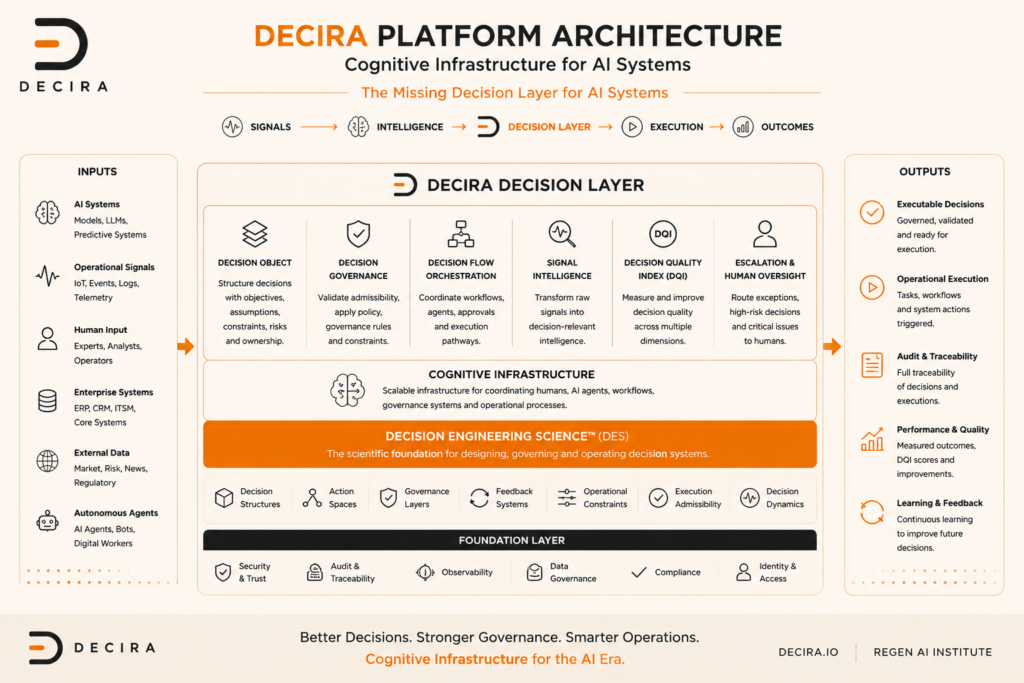
Traditional AI architectures focus primarily on data pipelines, model performance, and automation efficiency. However, as organizations scale AI systems, a new challenge emerges: the inability to govern how decisions are formed, validated, constrained, and executed across interconnected systems. DECIRA Architecture addresses this problem by introducing a structured decision infrastructure layer capable of transforming AI-generated outputs into governed, auditable, and operationally admissible actions.
At the core of DECIRA Architecture lies the principle that prediction alone does not constitute decision-making. AI models can generate recommendations, forecasts, classifications, or autonomous actions, but enterprise systems still require operational governance structures capable of validating whether those outputs should be executed, escalated, modified, or rejected.
DECIRA Architecture introduces a multi-layered cognitive infrastructure model composed of signal intelligence, decision governance, execution control, orchestration systems, and adaptive feedback mechanisms. This architecture enables organizations to move beyond isolated AI systems toward fully governed cognitive operations.
Core Components of DECIRA Architecture
Signal Intelligence Layer
The Signal Intelligence Layer captures and structures incoming signals from enterprise systems, AI agents, APIs, workflows, external environments, and human interactions. Rather than treating all information equally, DECIRA Architecture prioritizes signal relevance, contextual weighting, and operational admissibility.
This layer enables organizations to reduce signal noise, improve decision clarity, and strengthen systemic coordination across distributed AI environments.
Decision Engineering Layer
The Decision Engineering Layer transforms raw signals and predictions into structured decision objects. This layer operationalizes:
- decision ownership
- constraints management
- objective alignment
- governance validation
- risk evaluation
- transparency requirements
- auditability mechanisms
By formalizing decision structures, DECIRA Architecture enables organizations to create repeatable, explainable, and measurable decision systems.
Decision Control Layer
The Decision Control Layer acts as the runtime governance engine of the platform. Before any AI-generated output triggers execution, DECIRA validates operational admissibility against governance policies, enterprise constraints, compliance frameworks, and execution rules.
This architecture helps organizations reduce:
- uncontrolled autonomous execution
- governance drift
- compliance failures
- operational instability
- feedback degradation
- AI-induced systemic risk
Cognitive Orchestration Infrastructure
DECIRA Architecture orchestrates interactions between agents, workflows, enterprise systems, APIs, and human stakeholders. This orchestration layer coordinates how decisions propagate across operational environments while maintaining governance integrity and execution traceability.
The architecture supports scalable coordination across:
- autonomous agents
- enterprise workflows
- multi-agent systems
- human-in-the-loop operations
- compliance systems
- governance protocols
- Adaptive Feedback and Learning Systems
Modern enterprises operate in continuously evolving environments. DECIRA Architecture integrates adaptive feedback loops that monitor decision quality, execution outcomes, and governance integrity over time.
This enables organizations to detect:
- decision drift
- signal degradation
- operational instability
- governance failures
- execution bottlenecks
- systemic misalignment
Why DECIRA Architecture Matters
As enterprises increasingly deploy AI systems, the challenge shifts from model performance toward operational governance and decision stability. Organizations no longer suffer from lack of AI capability; they suffer from fragmented decision architectures.
DECIRA Architecture provides the foundation for:
- governed AI execution
- enterprise cognitive infrastructure
- operational decision intelligence
- AI governance systems
- cognitive orchestration
- decision quality management
- scalable multi-agent coordination
The platform is designed for enterprises operating in regulated, high-complexity, or mission-critical environments where governance, auditability, accountability, and operational reliability are essential.
Enterprise Applications
DECIRA Architecture can support multiple enterprise domains, including:
- AI governance infrastructure
- enterprise automation systems
- agentic AI operations
- healthcare decision systems
- financial governance platforms
- industrial operations
- public sector governance
- cognitive enterprise transformation
- decision intelligence platforms
Cognitive Infrastructure for the AI Era
The future of enterprise AI will not be defined solely by better models or larger datasets. It will be defined by the ability to govern how intelligent systems make, coordinate, validate, and execute decisions across complex environments.
DECIRA Architecture establishes the operational foundation for this transition by creating a scalable cognitive infrastructure layer capable of supporting governed AI systems at enterprise scale.
As organizations move toward autonomous and multi-agent environments, DECIRA Architecture provides the structural framework necessary to transform AI capability into stable, auditable, and trustworthy operational execution.